
InfluencesPage last updated 10/20/2019 |
Michael Palin Globe Trekker Worlds Apart Anthony Bourdain Dr. Zahi Hawass Bruce Parry Karin Muller |
Mark Anstice & Olly Steeds Brad Newsham Insight Guides Josh Gates Music Friends, Family... |
 Michael Palin |
|
Travel Documentary SeriesEver since Michael Palin (of Monty Python fame) attempted to go Around the World in 80 Days in 1986, I have been addicted to his travel programs. Craig and I have subsequently enjoyed Pole to Pole, Full Circle, Hemingway Adventure, Sahara, Himalaya, New Europe, and Brazil.Although we had both travelled a great deal in the United States, it was Palin's thoughtful, intelligent, humble, and humorous glimpses of the rest of the world that inspired us to get a passport and start exploring other countries. In fact, we had never even heard of Bhutan before seeing Michael's Himalaya series, yet we were immediately enchanted by the idea of it, and found ourselves there several years later. In May of 2018, Palin made an historic visit to North Korea. A two part series called North Korea from the Inside with Michael Palin was broadcast several months later. It was fascinating.At the start of his journey, Palin admitted that he was only being shown what the government wanted to see, but described it like this: What I hope is that although it will be controlled, I know that our movements...all that...that we'll get beyond that and actually get to know or meet or just observe the people themselves: the North Koreans who live there and work there and play there and bring up their children there and go to school there ...you know if I can do that, if I can get beyond the politics, beyond, if you like, a very strict regime, I want to find hopefully the people who live there see us as fellow human beings, 'cause that's the point of traveling and going 'round the world is to see that people actually are much much closer to us than we think. - North Korea from the Inside with Michael Palin, Episode 1Yes! It is so nice to see that after 32 years of traveling the world as a journalist, he has not become disillusioned. This was the message that he has been preaching since Around the World in 80 Days, and inspired us to approach travel in our "Anecdotal Anthropologist" style. WritingsMichael Palin compiled entries from his travel diaries and released companion books to each of his series (well, all except North Korea. I hope that one is forthcoming). These books contain lots of detail, and are enhanced by photographs by Basil Pao.He has also released a three volume set of The Michael Palin Diaries, which consists of The Python Years, Halfway to Hollywood, and Traveling to Work. The latter, which begins at the conclusion of 80 Days, contains some interesting personal insights as Palin first tries on his travel presenter persona, not knowing whether he will be successful or not. My contribution, I think, will not be precision, analysis, and revelation, but honesty, directness, openness, and enthusiasm. I hope I reflect the fact that anything can happen on a journet if you allow it to. (p.6) I feel, for better or for worse, that the best way I could make a contribution to the project was to be natural throughout - but going around the world with a film crew isn't a natural thing to do, and this is where I've becone a little unstuck. I try to be me, I try to be as natural as possible, and yet time and again I have to act, either look happy when I'm bored, or interested when I'm tired, or enthusiastic when I'm feeling ready to quit. I can act - I can act characters of all sorts til the cows come hme- but I can't act me. (p.14) It became increasingly obvious to me during these years that I was addicted to travel and there was no point in resisting the lure of map and atlas. (p. xxii) Michael Palin has also written some thoroughly enjoyable fiction: Hemingway's Chair and The Truth. The latter is even more topical now than a few years ago when it was written, given the fake news phenomenon. We wrote to Michael Palin after our first international (life-changing) Peru trip, thanking him for inspiring us. He sent us a personalized autographed photo, wishing us happy travels. We hope to one day get a chance to meet him in person. 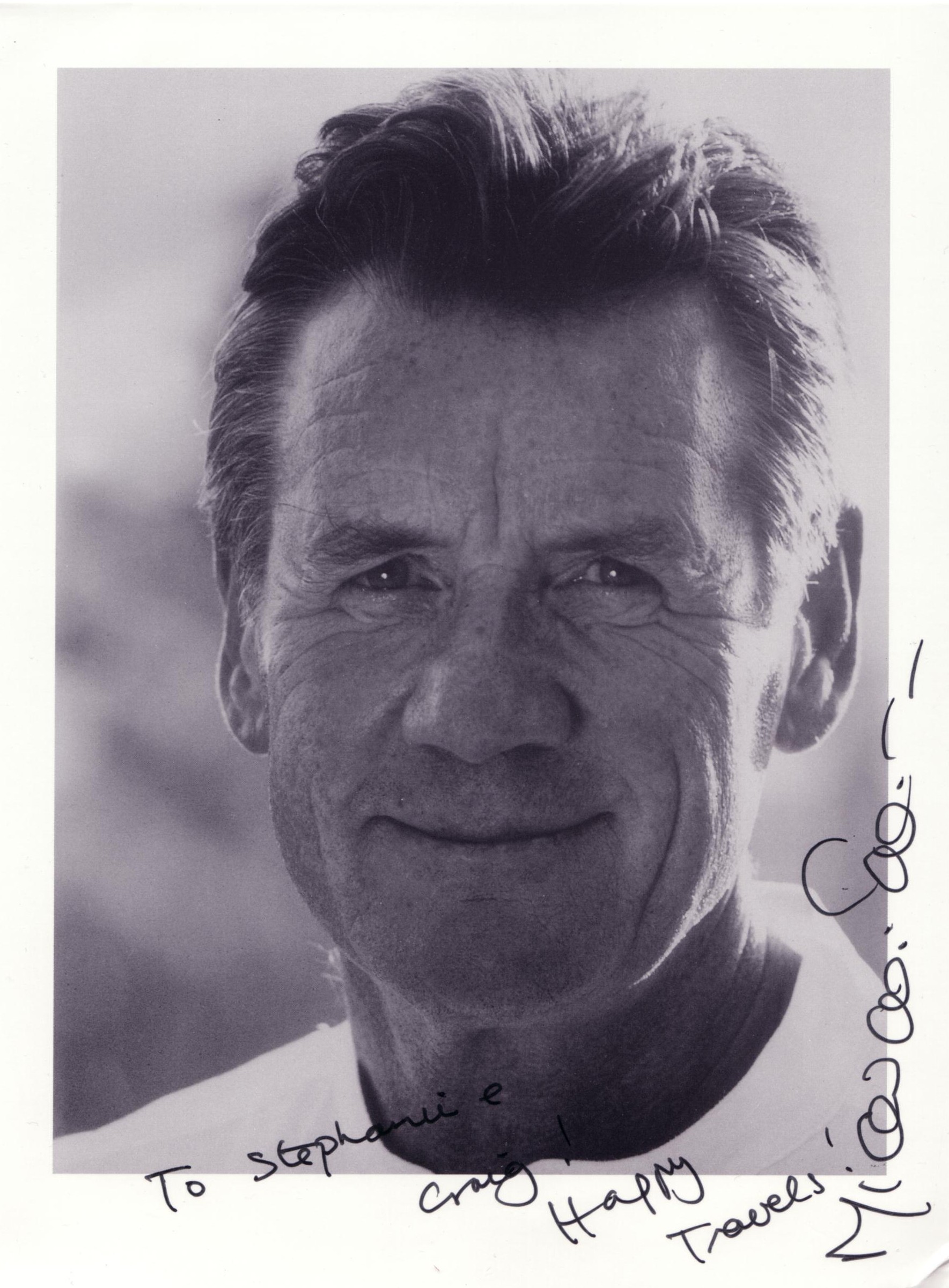 |
 Social MediaOn 2/19/2003, I asked the following during an online chat with Michael: stephlynne: Do you consider traveling with a camera crew to give you more or less of an "authentic" experience than the average traveler? Being a member of the press must give you access to many opportunities that a regular person would not have, but at the same time, has it been a hindrance because there are certain things and events that people do not want you to film?Michael Palin has a wonderful online community of fans. There are two lovely women that we met online through the chat board of his web site, Palin's Travels, whom we ended up meeting in real life during our travels. When I posted on the message board that we were visiting New Zealand in 2003, Ellen wrote to me and offered to go to dinner with us in Christchurch. We met her along with her husband and two daughters on the day we arrived, and it was a lovely introduction to their beautiful country. I met Carmen through the website in 2009. She was living in Switzerland at the time, and we became Facebook friends. By 2019, she had moved back to her native Australia, and was living near Sydney. We were very excited to get to finally get to meet her after all these years when we visited Sydney. We clicked immediately and spent a wonderful day together at the zoo. We are very appreciative that Michael Palin's website introduced us to these wonderful ladies with whom we have so much in common! 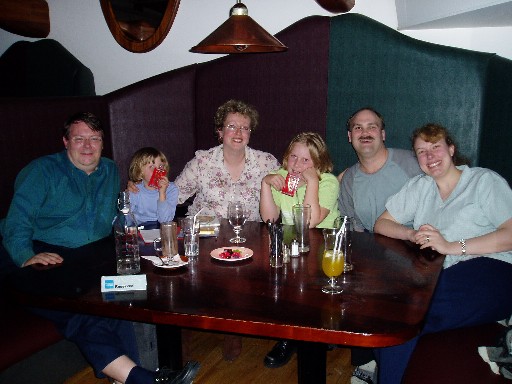 Dinner with Ellen and her family in Christchurch  Fun at WILDLIFE Sydney Zoo with Carmen One of my favorite quotes on Michael Palin's website is an encouragement for people to break down barriers between nations and cutures at a personal level: "Remember that the more we talk to each other – in every country - the safer the world will be." |
Globe Trekker |
|
|
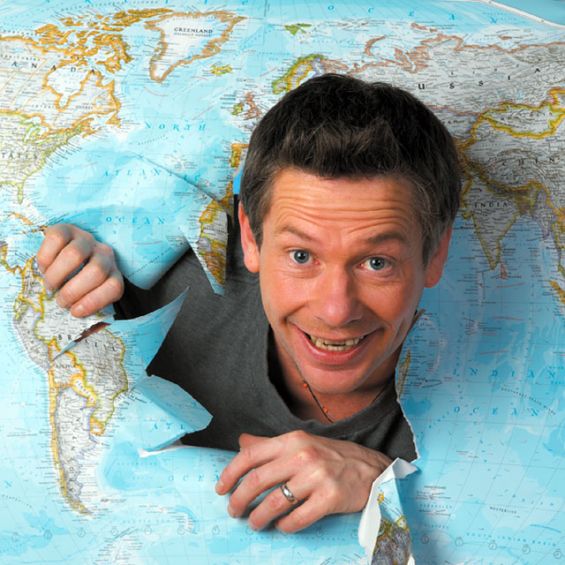
Globe Trekker is another travel program that we enjoy. Each week a presenter (Ian Wright, Meghan McCormick, Justine Shapiro, Zay Harding, and others) travels to some exotic locale and gives a very entertaining tour of the place on a budget. We've seen some episodes (after the fact) of places we have been, such as Alaska and New Zealand. It was neat to see Ian enjoying McCarthy, Alaska, and bungying off the Kawarau Bridge in Queenstown just like we did.
And some of the episodes we have seen have inspired us to visit new places. Justine Shapiro's La Ruta Maya convinced us that we had to go to Antigua, Guatemala during Semana Santa, a decision that ultimately greatly impacted our lives. It was on that trip that we first met Humberto, whose family would become our first compadres. On 5/29/2003, I had the opportunity during an online chat to ask Ian Wright the same question that I had asked Michael Palin. Here's his response: stephanie:Do you consider traveling with a camera crew to give you more or less of an "authentic" experience than the average traveler? Being a member of the press must give you access to many opportunities that a regular person would not have, but at the same time, has it been a hindrance because there are certain things and events that people do not want you to film?In January of 2004, Pilot Guides (the producers of Globe Trekker) published a story of ours on their web site! |
|
Worlds Apart |
|
|
Worlds Apart was a reality show on the National Geographic Channel in which a typical American family was sent to the other side of the world for ten days. They lived with a local family who taught them about their culture. Each member of the American family is expected to participate in the daily routine of their host family.
On day one, the family is enthusiastic. By day two, many tears are shed as families try to adapt to their adopted way of life. Since children are involved, this period can be quite an adjustment. By day three things are usually looking a bit brighter, and by day nine, when it's time to come home, everyone in the family has had a cathartic moment and is quite sad to have to leave. It is an honest portrayal of the culture shock that is felt by the American family and the host family. It is portrayed in a sensitive manner, but it doesn't shy away from poking good-natured fun at the participants at various stages of their trip. It's a shame that these haven't been released on DVD, as they are very enjoyable. When these shows aired in the early 2000's, we were transfixed. At the end of each episode, a group photo was taken of the two families together, and you knew that the families would have a bond for life. We thought about how great it must be to have that kind of connection with people from across the world. And now, a little over 10 years later, we are lucky enough to have those kinds of connections. People we have met on our travels have become lifelong friends and members of our extended family. We have official compadres in Guatemala and Ecuador, who share their children with us as godchildren, and we love them like our own. And we have unofficial compadres in Bhutan, China, India, and Vietnam. |
 
|
Anthony Bourdain |
|
|
Anthony Bourdain was a New York chef who has hosted several programs on the Travel Channel (No Reservations and The Layover), and a series called Parts Unknown on CNN. He ate, drank, and snarked his way around the world in search of culture and a good meal. His irreverent style and sense of humor endeared him to us, and we never missed an episode of his show. We loved his shows on the Travel Channel, and were happy to find that the CNN show is just as good, if not better in some ways. CNN gives him the opportunity to visit some places that were difficult if not impossible for him to access via the Travel Channel, and the result is great journalism: insightful commentary and a visual glimpse into cultures that are sometimes misunderstood. He even shared a meal with President Obama in a small neighborhood restaurant in Hanoi. Travel isn't always pretty. It isn't always comfortable. Sometimes it hurts, it even breaks your heart. But that's okay. The journey changes you; it should change you. It leaves marks on your memory, on your consciousness, on your heart, and on your body. You take something with you. Hopefully, you leave something good behind."We were shocked and saddened to hear of his death in June 2018. Rest in peace, Tony; your work has been so inspirational to us. |
  |
Dr. Zahi Hawass |
|
|
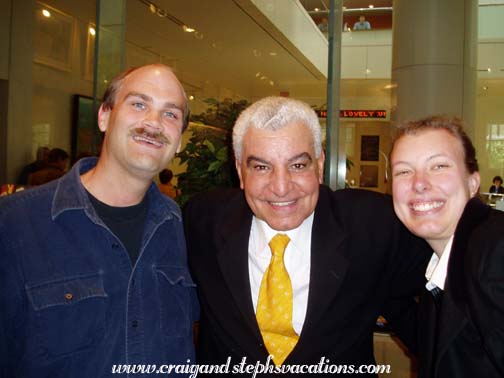
If you have ever seen a program about Egypt on television, chances are that you've seen Dr. Zahi Hawass. As former Secretary General of the Supreme Council of Antiquities in Cairo, his passion and enthusiasm for his work was unrivaled. After enjoying many of his television programs and reading articles that he wrote for National Geographic (he is a National Geographic Explorer-in-Residence), we have gained a lot of respect for him. We went to see him give a lecture at the Museum of Fine Arts in Boston on May 5, 2004. He gave a riveting slideshow/lecture which was punctuated by his great sense of humor. He did a booksigning after the lecture, and we had the pleasure of meeting him and telling him that we really enjoy travel and he has inspired us to go to Egypt some day.
We actually planned a trip to Egypt and Jordan in 2009 through National Geographic Adventures. We chose that particular trip because it featured a lecture by Dr. Hawass. However, the trip was canceled because it didn't get the required number of participants, so we went to Mali instead. For a while, we missed our chance, as Dr. Hawass resigned following the Egyptian protests in 2011 during which many antiquities were looted from the Egyptian Museum in Cairo. But about 5 years ago, Dr. Hawass started working with Archaeological Paths. We were happy to hear that there was another opportunity to travel to Egypt and benefit from his expertise, and decided to book a trip. Unfortunately, Steph's mother passed away from pancreatic cancer during the scheduled departure, so we were unable to travel there in 2018. Egypt just doesn't seem to be in the cards for us, unfortunately. |
|
Bruce Parry |
|
|
Bruce Parry is the host of a wonderful television program which goes by the name of Going Tribal in the USA and Tribe on the BBC. Bruce visits various tribes arond the world (the Darhad of Mongolia, the Suri of Ethiopia, the Kombai of West Papua, the Babongo of Gabon, the Adi of the Himalayas, the Sanema of Venezuela, the Dassanech of Ethiopia, and the Hamar of Ethiopia) and actively participates in their lifestyle. He will try just about anything, and gets to truly understand the cultures as much as an outsider can. This show inspired our visit to the Maasai in Kenya and Tanzania. As we experienced various things, such as Craig trying the Maasai's aloe beer, we said that we felt like Bruce Parry.
He has since done additional series for the BBC including "Arctic" and "Amazon". |
 |
Karin Muller |
|
|
A few months after returning from Peru, I ran across Karin Muller's Along the Inca Road in a bookstore. I bought it and read it soonafter. Karin's funny and learned style of writing was a joy to read. Her story of hiking alone down ancient Inca "highways" in South America was very intriguing. We saw an interview with her on the National Geographic Channel, during which she showed video footage from her South American trip. She also talked about her previous book, Hitchiking Vietnam. I managed to track down a copy and found it every bit as insightful and entertaining as Along the Inca Road, only this one was set in a place I had not visited yet (though we would visit it in 2013). I sent Karin an email telling her how much I admired her work and travels. She wrote a nice message back, which concluded with "Enjoy your life and your travels. And be safe. But not too safe." Craig and I believe this credo. Especially since 9/11, a lot of Americans have been afraid to travel within the States, let alone abroad. But if we had let fear govern our lives, we never would have had the wonderful travel experiences that we have had. |
 |
Mark Anstice & Olly Steeds |
|
|
Mark Anstice and Olly Steeds spend months at a time with remote tribes and have produced 3 series on the Travel Channel. Their first two series took place in West Papua – Living with the Kombai and Living with the Mek. Their most recent series was Living with the Machigenga in the Peruvian Amazon.
Mark and Olly come at their adventures from different perspectives. Mark is an ex-Army captain with a competitive streak who is skilled at survival techniques and wants to learn new skills from his time with the tribes. Olly is a journalist who is interested in documenting the customs of the tribes. The tribes that they have visited thus far have been patriarchal, and the villagers tend to view the more skilled Mark as a man, while they relegate Olly to work with the women. This generally works out for Olly, as he is able to see first-hand into the women’s world and gains a lot of insight from them. Mark and Olly show up in tribal villages unannounced, and ask if they can stay for a few months to learn about the tribe’s culture. These tribes are not used to outsiders, and are very suspicious of the pair at first. Since they are able to stay for several months, they really have time to break down the barriers and become comfortable in the village. It is interesting to watch the dynamics as the tribe accepts them little by little until they are an integral part of the village "family" (In the Machigenga series, the chief even urges them to participate in a contest to win his daughter’s hand in marriage!) Try as they might to try to live by the tribes' rules and taboos, occasionally they accidentally cause offense. This causes awkward and, sometimes even dangerous situations. But their sincerity and genuine interests in the tribes prevail, and the tribes eventually grow quite attached to them, and view them as their own "sons". We often wish that we had several months to spend in a place, so that we could really get an in-depth knowledge of a particular culture. Maybe some day... In January 2010, Olly's new series Solving History with Olly Steeds premiered. |
 We had a chance to ask Olly our favorite question on his blog Steph & Craig Says: December 26th, 2009 at 9:13 pm Hi Olly, My husband and I are avid travelers and have really enjoyed your work. We are curious about something: Do you consider traveling with a camera crew to give you more or less of an "authentic" experience than the average traveler? Being a member of the press must give you access to many opportunities that a regular person would not have, but at the same time, has it been a hindrance because there are certain things and events that people do not want you to film? Thanks and keep up the good work! Steph & CraigAnd here is his response: Olly Steeds: Steph and Craig: tricky one – well it largely depends on the situation and the people you want to meet. Obviously the more delicate the situation and the less invasive you need to be, the more important it is to have smaller teams. Ideally I prefer to travel with one other person, to share in the experience and obviously compliment my usually failing knowledge or skill base. Usually the smaller the team, the more opportunities, the less threatening you are, the greater the contact you can have with people and situations you cross paths with on the road. On the other side, working with a film crew or being a journalist provides greater purpose and focus to a journey, can really help to open doors, facilitate logistics and provide encounters with experts, locals etc which otherwise wouldn’t be possible. In Solving History, we mix up the size of the team, so where appropriate I work with just one person, other times, we’ll have a full crew. |
Brad Newsham |
|
|
I was looking for interesting travelogues to read when I ran across Brad Newsham's Take Me With You: A Round-the-World Journey to Invite a Stranger Home. The book is the true account of a California cab driver's trip around the globe in the hopes of finding someone to invite back to the United States for a visit. Newsham has a big sense of humor and a big heart, and the book is very uplifting. This book was very inspirational to us in terms of forging meaningful friendships across cultures.
Newsham is also the author of All the Right Places. |
 |
Insight Guides |
|
| We first ran across Insight Guides while doing research for our trip to Peru. When browsing through the travel section at the bookstore, our attention was immediately grabbed by this brightly colored book. It contained beautiful full-color photographs, as well as extensive historical, geographical, and cultural information. It's now over 15 years later, and we have pretty much purchased an Insight Guide as part of our pre-trip preparation for each new destination. |

|
Josh Gates |
|
|
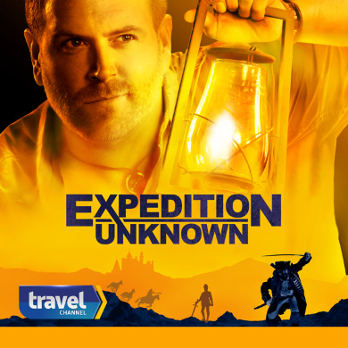
Josh Gates is a local North Shore Massachusetts boy, which explains why we identify so much with his snarky sense of humor. His series Expedition Unknown on the Travel Channel is a smart, insightful, and funny exploration of various historical mysteries and arguable urban legends around the world.
He introduced us to the mystery of what happened to St. Petersburg's Amber Room after it was looted by Nazis during WWII. On our trip to Russia in 2017, we saw the painstaking replica of the amber room at Catherine Palace. We also enjoyed seeing him search for the Great Bell of Dhammazedi in Myanmar, an episode that we rewatched after our visit in 2016. |
|
Music |
|
|
Music is also a great impetus for traveling. Craig and I both have eclectic taste in music (so eclectic that we've literally seen Black Sabbath in concert one night and the Boston Symphony Orchestra the next), and we have often planned travel to include various performances.
We have traveled all sorts of places to see Tom Waits (Oakland, Vancouver, Berlin, Atlanta, Memphis, Nashville, Columbus) and Rick Wakeman (London, Trois Rivieres, Quebec City). We took a trip to Memphis for the W.C. Handy Blues Awards and to visit Rev. Al Green's church for music-filled Sunday service. We have gone to Chicago on several occasions to check out their blues scene. We chose our Mali trip because it combined volunteer work in a Dogon community with a trip to the Festival au Desert, a world-acclaimed music festival in the Sahara, just north of Timbuktu. Not to mention that Malian music is the forefather on American blues! We enjoy live music at home as well, and have a page devoted to concerts we have seen in the Boston area. |
 |
Friends, Family... |
|
|
Our good friend Marty in St. Thomas said, after reading this page,
"I was really surprised to see that I wasn't one of your "Influences"! regarding travel! Sheesh! I figured, you came here, met me, now you've got the VI bug! It MUSTA been influenced by me...RIGHT?!? Haha!" Marty, you are absolutely right! Though what may initially have inspired a trip could be a book, television show, movie, etc., the most salient memories of our travels are the people we meet along the way. Nothing pleases us more than meeting, learning from, and connecting with people around the world. One of the most joyous things about revisiting a place is the opportunity to reconnect with friends, and one of the most exciting things about traveling to a new place are the seemingly endless opportunities to make new friends. We have dear friends around the world, and today's technology makes it easy to keep in touch. |
 |
 |

|
 |


